4 Nov
A backyard court fails in two different places. The playing surface can lose traction or hold water, and the porcelain paver sports court surfacing around it can rock, stain, or bake in the sun. Homeowners, designers, and contractors in Jupiter, Boca Raton, and Fort Myers often want one material to do both jobs. Porcelain can handle the walking paths, spectator edges, and borders. The marked play area still needs a sport surface built for that game.
Call (561) 998-5000 to review your court layout before you order pavers.
This guide covers the decision you should settle before a purchase order. It explains where porcelain belongs, which thickness fits foot traffic versus service vehicles, and how a sand-set base, slope, and joint plan keep the court surround usable in Florida weather. It does not replace a sport-surface specification, a single-sport buying guide, or a maintenance contract.
Porcelain paver sports court surfacing is the porcelain field used on the walking and viewing areas of a court, not the painted play surface itself. Think of the apron outside a basketball key, the path from a lanai to a pickleball court, or the border a crowd stands on during a match. Those zones take shoes, chairs, coolers, and Florida rain. They do not need bounce, line paint, or a certified ball response.
Porcelain pavers are dense outdoor pavers fired at high heat. Hardscape.com supplies them in 2CM, 3CM, and 5CM thicknesses, plus coping and installation accessories. On product pages for individual colors, water absorption is listed at 0.5 percent or less. That low uptake is why the pavers resist deep stains and do not need a sealer the way porous concrete and many natural stones do.
The play box is a different assembly. A sport-surface specification should call for a drained, uniform, non-glare surface with controlled texture and speed. Acrylic color systems, cushion layers, and painted lines belong to that specialty trade. A porcelain field can meet the court. It should not be described as the game surface.
The bottom line: Use porcelain for the paths, borders, and spectator edges. Keep the marked play area on a sport surface specified for that game.
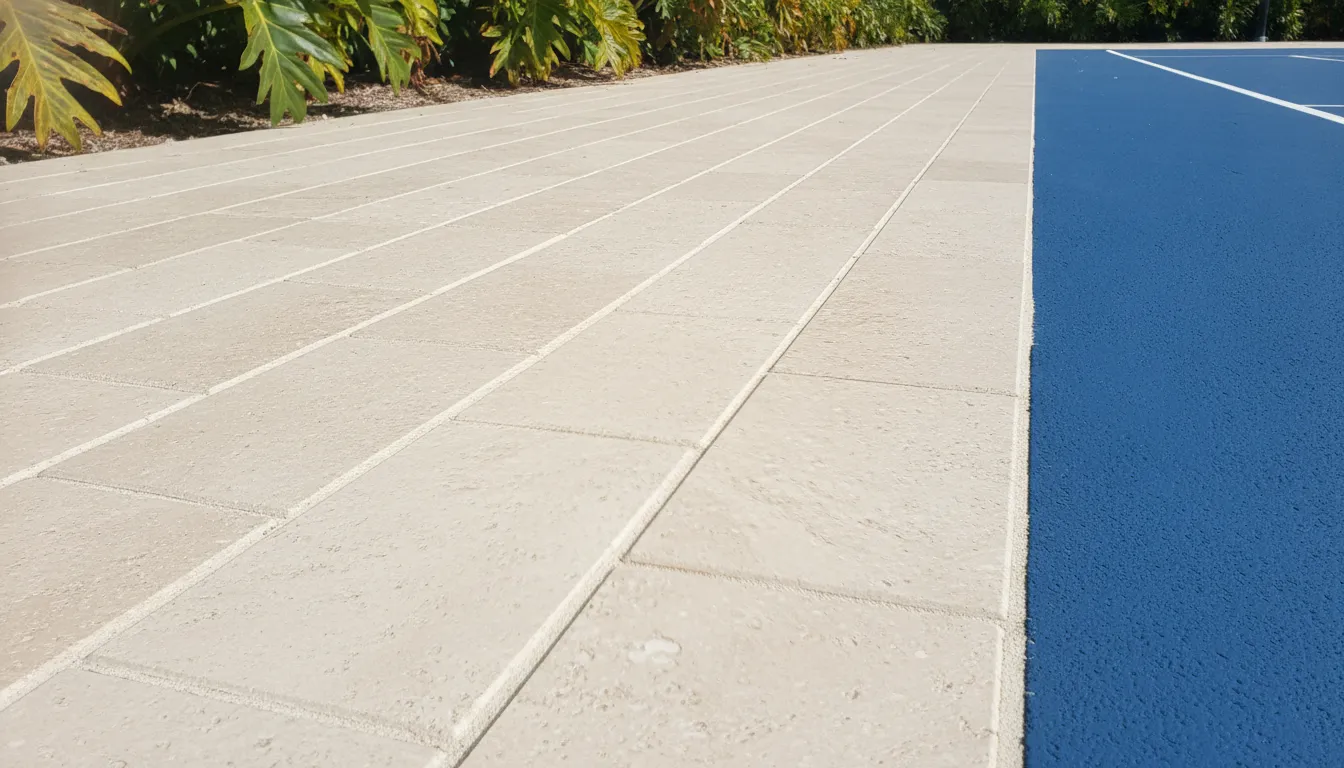
Draw the line on paper before anyone talks thickness. The play area is the rectangle inside the outer painted lines, plus the out-of-bounds run-off the sport's rules expect. Porcelain should stop at a clean joint outside that run-off. A player chasing a ball should not hit a paver edge, a thickness change, or a loose joint sand line mid-stride.
Large-format pavers look clean beside a court, but they change how you turn corners and set a border. The large-format versus small-format comparison is the right place to settle module size. This article stays on the court-surround decision.
The bottom line: Porcelain owns the approach and the frame. The sport surface owns the play box and its required run-off.
Thickness follows the load, not the sport logo. A quiet residential path is not the same job as a club court that a utility cart crosses every morning. Hardscape.com groups outdoor porcelain into three thicknesses, and the live category pages show where each one is meant to be used.
| Thickness | Typical court-surround use | What to confirm before ordering |
|---|---|---|
| 2CM (about 3/4 inch) | Residential foot paths and patio-style borders with no vehicle traffic | Sand-set base, edge restraint, and a joint plan. Not a vehicular installation. |
| 3CM (about 1-1/8 inch) | Busier borders, light service access, and commercial pedestrian edges | Confirm the base section with your installer if a cart or light vehicle will cross. |
| 5CM (about 2 inches) | Heavy-duty edges, drive lanes, and commercial approaches beside a court | Use only where the project truly needs heavy-duty thickness. Review samples for color. |
Do not stretch one SKU's lab number across every color. A single 2CM product page can list breaking strength at 13,000 N or higher, and one 3CM product page lists 29,672 N. Those figures describe those products. They are not a promise that every court border will carry a truck. For a heavy approach or a fire lane, start with the 5CM porcelain pavers and have the installer design the base. For a home path, the 2CM porcelain pavers are the usual residential choice. Busy borders and light service access usually start with the 3CM porcelain pavers.
Vehicular claims belong in the driveway guide, not here. If the only wheels on the porcelain are a maintenance cart, say that in the specification so the base is built for it. Guessing "commercial" and ordering 5CM everywhere wastes material and does not fix a bad slope.
The bottom line: Match 2CM to foot traffic, 3CM to busier light-duty edges, and 5CM only where the approach is truly heavy-duty.
Hardscape.com porcelain is installed sand-set. Use the approved sand-set system for the selected product and site conditions. A sand-set section lets water move down through the joints, and a single paver can be lifted later if a sleeve or drain needs work.
The usual sequence is simple, and your installer should adapt it to the soil report and the court builder's grades:
Accessories matter as much as the paver. Porcelain paver accessories include spacers, polymeric sand, blades, and coping. Coping is for pool edges and similar transitions, not a substitute for a court line. If the border meets a driveway, read the driveway paver guide for load and base questions, then keep this court's play area out of that design.
Cut pavers with a wet saw and a porcelain blade. A dry score-and-snap leaves a chipped edge that shows next to a crisp court line. Plan cuts so the joint against the play surface is straight. A wavy cut line is the first thing a player sees.
The bottom line: Build a restrained sand-set border on a compacted base, with even joints and polymeric sand, using the approved installation details for the selected product and site.
South Florida rain does not forgive a flat court. Water that leaves the play surface has to keep moving across the porcelain, into a drain, swale, or permeable joint, and away from the paver edges. If the border is the low spot, you have built a puddle next to the game.
The ASBA color-finish guidance says an impervious tennis court surface course should be built to a slope of about 0.83 to 1.0 percent before any color system goes on. That figure is a planning reference for the court builder, not a porcelain installation spec. Ask the court contractor what slope their system requires, then set the porcelain to meet that grade without a lip.
A practical flood check tells you whether the grades work. After a heavy rain, or after a hose test, walk the border. Water that still covers a nickel-sized spot an hour later is a birdbath. Fix the bedding before the sport surface is coated. Patching a low spot later means lifting pavers, not smearing filler across porcelain.
Porcelain joints are part of the drain path on a sand-set job. Keep them open enough for water and filled with the right polymeric sand so they do not wash out. Site drainage details, channel drains, and slope math are covered in the porcelain paver drainage guide. Use that page for the detail, and use this one to decide where the court hands water to the border.
Coastal sites in Palm Beach County and Lee County also deal with wind-driven rain and, in season, hurricane debris. The Florida hurricane preparation guide covers storm prep. Do not turn this court article into a storm manual. Do leave a gap in the schedule so pavers are not set the week a major system is forecast.
The bottom line: Match the border to the court builder's slope, send water off the play area, and fix birdbaths in the bedding before anyone coats the court.
Players notice heat on the walk from the shade to the court more than they notice it in a product brochure. Color is the main lever you control. Lighter porcelain stays more comfortable under bare feet and athletic shoes than a dark charcoal field in full afternoon sun. It will still get warm. No outdoor paver stays cool at 3 p.m. in August.
Porcelain's color is integral to the product rather than a separate coating, so skip any sealer plan. Skipping sealer is a real maintenance advantage next to concrete pavers, which often need sealing because they absorb stains. The comparison lives in the porcelain versus concrete guide. What matters here is that a court border collects sunscreen, sports drinks, and clay or rust from equipment.
Rinse spills the same day. A garden hose and a neutral cleaner handle most of it because the absorption rate is so low. Do not use acid washes, muriatic acid, or a pressure washer held an inch off the joint. You can blast polymeric sand out and leave a groove that fills with water.
Glare is a play problem even when porcelain is only the border. A high-sheen, very light paver at the west edge of a court can reflect into a server's eyes late in the day. Look at full-size samples outside, at the hour you play, before you approve a color. Showroom light is not court light.
The bottom line: Pick a lighter color, skip any sealer, rinse drink and sunscreen spills, and approve the paver outdoors at game time so glare stays off the court.
Order the porcelain field, the edge restraint hardware your installer specifies, spacers, polymeric sand, and enough extra pavers for cuts and a future repair. A court border has more angled cuts than a simple patio, so a 5 to 10 percent waste allowance is a fair planning start. It is not a quote. Your installer should count the actual cuts.
Leave these items off the porcelain purchase order:
Samples are the cheapest insurance. View the short list at a Hardscape.com showroom in Jupiter, Boca Raton, or Fort Myers, then set the finalists on the ground at the court. Wet one sample. Sunscreen, pool water, and a dropped sports drink should wipe off rather than ghost into the paver. If you need a written specification for a commercial set, ask for the current product data for the exact SKU. Do not paste a different color's strength number into the spec.
Contractors ordering for a client should also confirm delivery access. A pallet dropped on the future play area can scar the base the court builder just graded. The construction protection guide covers how to stage and cover material. Read it before the truck is booked.
The bottom line: Order pavers, spacers, sand, and extra pieces for cuts. Leave coatings, line paint, pedestal play surfaces, and unapproved installations off the order.
Three roles keep a court surround from becoming a change order. The owner or designer sets the sport, the size, and how people reach the court. The court builder owns grades, the play surface, lines, and equipment. The porcelain installer owns the sand-set border and the joint where it meets the play surface. One person should still coordinate the schedule.
A clean handoff looks like this. The court builder stakes the play box and states the finish elevation. The porcelain installer sets screed rails to that elevation and keeps a consistent joint at the meeting line. Neither trade feathers their material over the other's work. If a lip appears, stop and reset the bedding. Grinding porcelain to hide a grade miss leaves a dull scar.
Commercial jobs, HOA amenity decks, and club courts need the same honesty about maintenance. Porcelain's low absorption cuts staining and removes the sealing cycle common to concrete. It does not remove sweeping, joint checks, or the sport surface's own recoating schedule. Recurring care is its own topic, covered by the porcelain paver maintenance schedule. A service contract is a later buying decision, not part of this surfacing choice.
Choose an installer who has set exterior porcelain, not only brick pavers. The contractor selection guide lists what to ask. For a court, add one question: will they coordinate grades with the sport-surface contractor before the first pallet is opened?
The bottom line: One coordinator, two trades, and a written elevation at the joint. Do not let either trade cover the other's work to hide a grade miss.
Call (561) 998-5000 to compare court-border samples before ordering.
No. Use them for paths, spectator edges, and borders. The marked play area needs a sport surface with the texture, lines, and drainage that game requires. Acrylic color systems and cushioned courts are a separate trade.
For a residential walking border with no vehicles, 2CM porcelain on a proper sand-set base is the usual choice. Step up to 3CM if the edge sees heavier foot traffic or a light service cart, and consider 5CM only for a real heavy-duty approach. Confirm the section with your installer.
No. Quality outdoor porcelain absorbs about 0.5 percent of water or less, so it does not rely on a sealer. Rinse spills, keep joints filled, and skip coatings that claim to change the product's surface. Follow the current care guidance for the selected product.
Flat enough that water keeps moving and players do not trip at the joint. Court builders often target roughly 0.83 to 1.0 percent slope on an impervious tennis surface. Match the porcelain to the elevation they publish, then hose-test and fix any birdbath before the play surface is finished.
Confirm the approved sand-set method, base depth, edge restraint, joint treatment, finished elevations, drainage path, and transition detail for the selected product and location. The sports-surface contractor and porcelain installer should coordinate their scopes before materials are ordered.
Porcelain paver sports court surfacing works when you keep the jobs separate. Porcelain handles the walk, the watch, and the frame. A sport surface handles the play. Choose thickness for the real load, build a restrained sand-set base, and match the court builder's slope so Florida rain leaves the site.
Bring a sketch, the sport, and two or three color ideas to a showroom. Hardscape.com can walk the 2CM, 3CM, and 5CM options with you and point you to samples that fit the border, not the painted court. Call (561) 998-5000 or send the project details and ask for a site-specific quote.