12 Sep
Choosing between porcelain pavers and concrete pavers in Florida is a project decision, not a popularity contest.
Contact Hardscape.com for project-specific porcelain paver guidance and product recommendations.
Sun, heavy rain, humidity, irrigation, foot traffic, drainage, maintenance, and the look of the space all matter. The right material is the one whose documented properties and installation system match the site.
Quick answer: Porcelain pavers vs concrete pavers is a comparison of two different outdoor systems. Porcelain can offer low routine maintenance, moisture resistance, and broad design flexibility. Concrete can suit projects that prioritize its established material palette and a specified concrete system. Evaluate both against Florida exposure, drainage, traffic, upkeep, and installation quality.
This guide takes a broad Florida project-selection approach for homeowners, landscape designers, architects, and contractors. It does not duplicate a cost breakdown or focus only on pool decks. Instead, it explains how to compare the materials for patios, walkways, driveways, and commercial outdoor spaces.
In short: Porcelain pavers are dense, engineered outdoor surfacing products, while concrete pavers are cement-based units whose results depend on their mix, aggregate, exposure, design, and installation. That distinction shapes how teams assess moisture, maintenance, traffic, repair planning, and visual continuity in a Florida project.
Porcelain pavers are engineered for residential and commercial outdoor applications. Hardscape.com offers 2CM, 3CM, and 5CM product categories. The correct selection depends on intended use, traffic, access, climate exposure, and design intent. A thickness or performance statement for one product should not be generalized to every paver in the range.
Concrete pavers are not one universal performance category. The Federal Highway Administration's concrete durability guidance explains that durability concerns the ability of a material to resist its service environment. Cementitious components, aggregate selection, exposure, and construction quality all influence the result.
Florida projects must account for intense sun, frequent rain, humidity, irrigation, and varying levels of pedestrian or vehicular traffic. Those conditions make grading, base preparation, joint design, edge details, and qualified installation essential for either material. A paver material alone cannot guarantee drainage or long-term performance.
For additional comparison context, read Hardscape.com's porcelain pavers vs natural stone guide. That article covers a different material comparison, while this guide keeps the decision centered on porcelain and concrete.
The bottom line: Porcelain and concrete are not interchangeable systems. Compare documented properties against Florida exposure, traffic, drainage, maintenance expectations, design intent, and installation requirements.
In short: Both materials must be evaluated as complete systems. Porcelain can be useful where moisture resistance and low routine upkeep matter. Concrete can fit a project with a documented concrete specification. For either option, product selection, grading, joints, base conditions, drainage, traffic, and installation quality matter more than a material label alone.
Heat, rain, moisture, sunlight, and traffic can all affect an outdoor surface. Porcelain pavers are engineered for outdoor strength and moisture resistance. Low water absorption can be useful where repeated wetting and drying is part of normal weather exposure. Product selection must remain application specific.
Concrete can perform successfully in Florida when its mix, aggregate, design, drainage, placement, and maintenance are appropriate for the environment. The FHWA guidance emphasizes that durability depends on the material's ability to resist its service environment. Neither material should be evaluated without its system and site conditions.
Rainwater must be managed through grading, base preparation, joints, transitions, and drainage features. Traffic loads should be reviewed alongside access, turning movements, and intended use. For this guide, the porcelain installation discussion focuses on a planned sand-set system, with the complete assembly coordinated to the project.
For a broader look at a porcelain product category, review Hardscape.com's 3CM porcelain paver collection. Use current product documentation for the exact application.
The bottom line: Porcelain can provide a durable, moisture-resistant option for Florida applications. Concrete can perform well when its properties and system are matched to local conditions. Compare product documentation, exposure, traffic, drainage, and installation together.
In short: Porcelain can reduce routine maintenance because Hardscape.com describes its pavers as stain resistant and not requiring periodic sealing to maintain their properties. Concrete may suit other project priorities, but its care plan should address cleaning, exposure, appearance, and potential repairs.
Maintenance is more than a question of which surface looks newer after installation. Owners should ask how often the area needs cleaning, how stains are handled, whether sealing is part of the routine, and how an isolated damaged unit would be addressed.
Porcelain pavers are designed for low-maintenance outdoor applications and are resistant to staining. Routine care can focus on ordinary soil, leaves, spills, and seasonal cleaning rather than a recurring sealing schedule. Proper grading, base preparation, joint design, and sand-set installation still matter.
Concrete maintenance depends on the mix, aggregate, exposure, drainage, traffic, installation, and owner's care plan. Material-related distress can lead to repairs even when structural design is sound. That does not make concrete unsuitable. It means the project team should define cleaning, inspection, and repair expectations before approval.
Before choosing either material, identify who will document the installed product, how replacement units will be sourced, and whether the layout allows a damaged paver to be removed without disturbing a large area. For product-specific context, see Hardscape.com's 2CM porcelain pavers guide.
The bottom line: Porcelain can simplify routine care through stain resistance and no periodic sealing requirement. Concrete may fit different priorities, but its care plan should account for exposure, cleaning, appearance, and potential repairs.
In short: Drainage is determined by the planned outdoor assembly, not by the paver material alone. Review grading, base preparation, joints, edges, transitions, access points, and outlet locations before selecting a product. For the patio and walkway applications covered here, plan the porcelain pavers as a sand-set system with a qualified project team.
Hardscape.com's porcelain paver product collection can help a project team review available product directions. The final specification should be based on documented product information and the site plan.
The bottom line: Drainage and installation planning are material-selection criteria. Match the system to grading, base conditions, joints, transitions, access, and intended use. Confirm that qualified installers can execute the sand-set plan.
In short: Design works best when product scale, texture, pattern, architecture, movement, drainage, and maintenance are considered together. Patios can use calm proportions, walkways can reinforce direction, and commercial spaces can use repeatable details. Resolve transitions before materials are ordered.
Design should begin with how the space will be used, then move to scale, visual rhythm, and transitions. Patios may benefit from generous modules that make an outdoor room feel calm. Walkways need a clear directional layout. Commercial spaces often benefit from repeatable dimensions that coordinate across a larger footprint.
| Decision | Patio | Walkway | Commercial space |
|---|---|---|---|
| Size | Use proportion to create a calm outdoor room. | Choose dimensions that reinforce comfortable movement. | Favor repeatable modules that coordinate with the site plan. |
| Pattern | Aligned grids can create a quiet, expansive field. | Directional layouts can guide visitors. | Repeatable patterns can define zones without clutter. |
| Transitions | Plan edges where paving meets planting or walls. | Coordinate direction, elevation, and adjacent surfaces. | Detail thresholds and access points early. |
Porcelain pavers are available in varied sizes and textures, including large-format and wood-look appearances. Select products with the architecture, landscape, intended movement, drainage features, maintenance plan, and documented product information in mind.
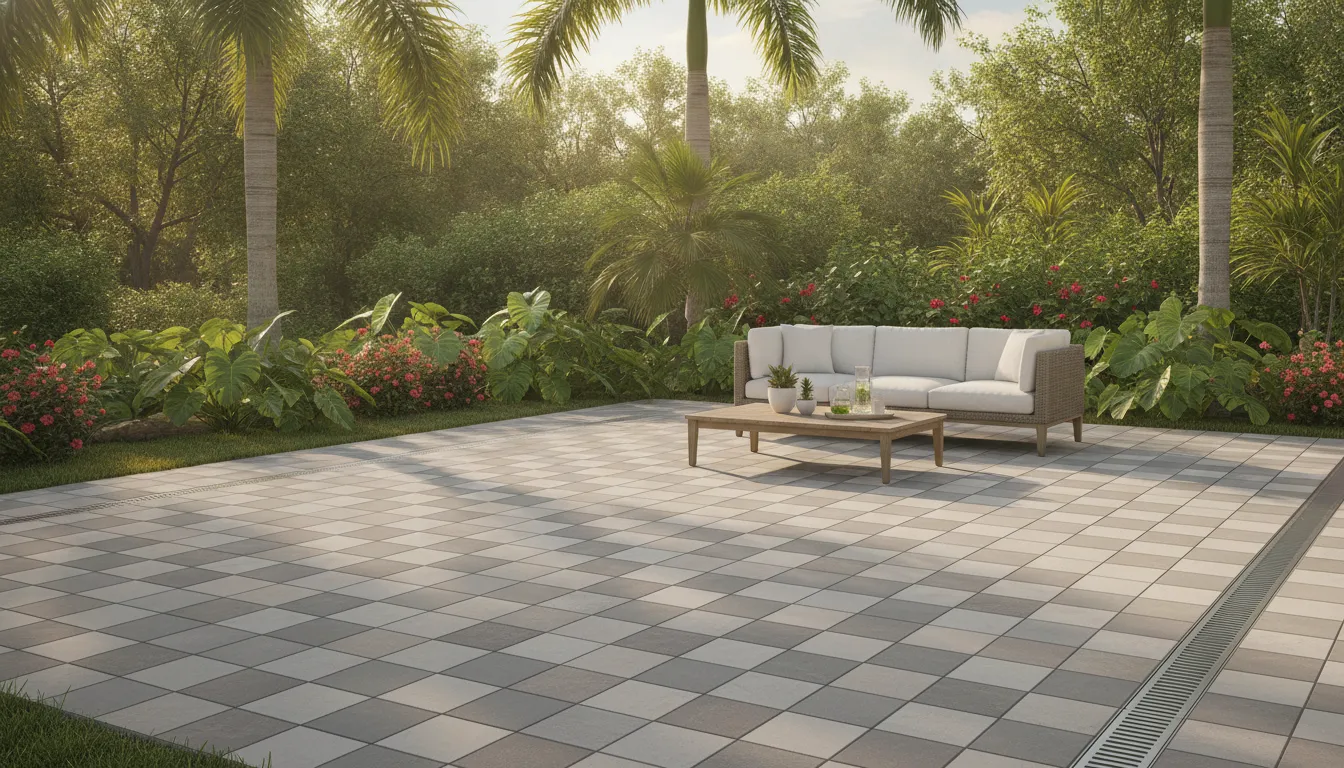
Color, scale, and texture should support the building rather than compete with it. Large-format layouts can complement clean architectural lines, while wood-look appearances may add warmth to a covered patio or garden approach.
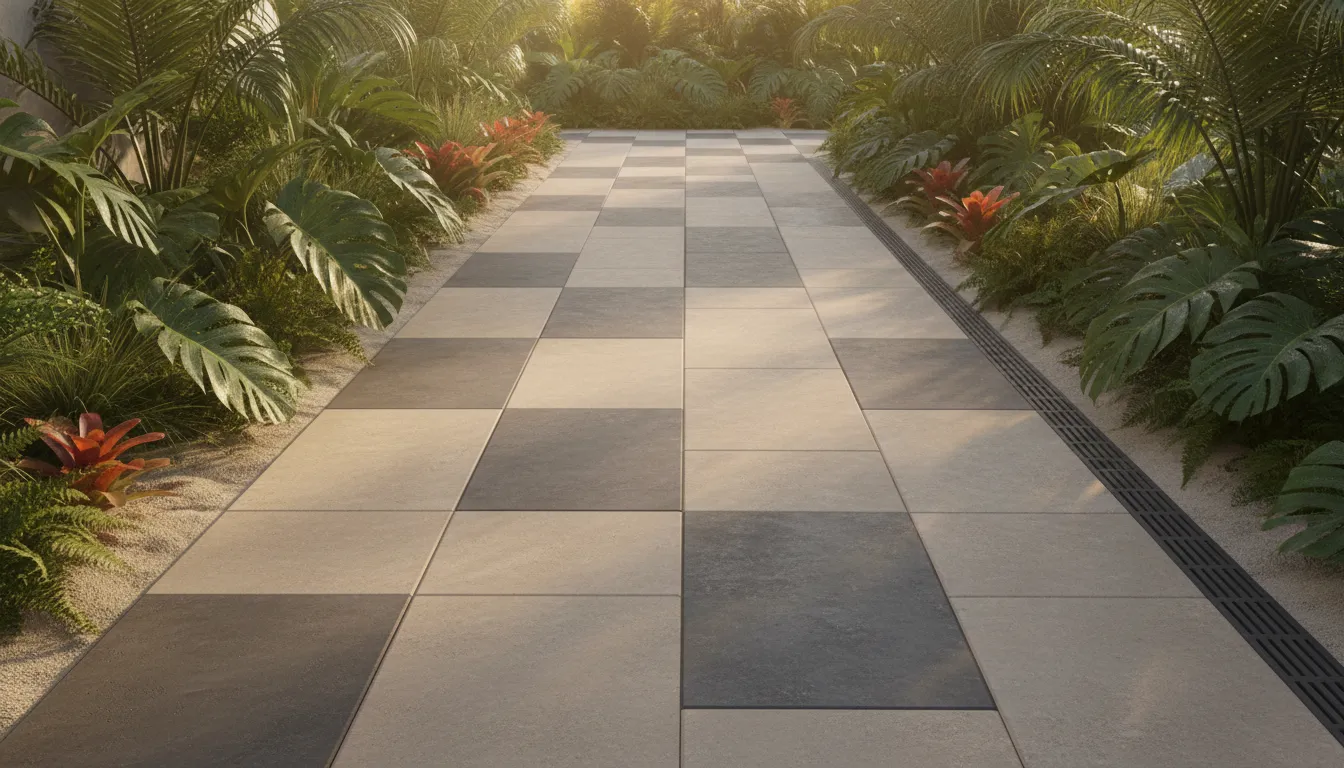
The bottom line: A successful design connects product scale and texture to architecture, movement, drainage, and daily use. Florida patios, walkways, and commercial spaces each need a deliberate visual and functional plan, with transitions and maintenance expectations resolved before materials are ordered.
In short: Porcelain is often a strong fit when a Florida project values moisture resistance, stain resistance, low routine maintenance, design flexibility, and a carefully planned sand-set system. Concrete may fit when its documented properties and project system better match the brief.
Concrete may be the better fit when a project has a documented concrete specification, a design brief centered on its material palette, or an installation and maintenance plan built around that system. Do not select either material solely from a generic claim or an isolated image.
The bottom line: Choose porcelain when moisture resistance, low routine maintenance, design flexibility, and a planned sand-set system align with the project. Choose concrete when its documented properties and project system better fit the brief.
Talk with Hardscape.com about porcelain paver options for your Florida project.
Quick FAQ summary: The better material depends on the Florida site's exposure, traffic, drainage, maintenance expectations, design intent, and installation system. Porcelain can offer low routine upkeep and design flexibility, while concrete may fit a project with a documented concrete specification.
Not universally. Porcelain can be a strong fit when a project values moisture resistance, stain resistance, lower routine maintenance, and design flexibility. Concrete can also perform well when its material properties, drainage plan, installation, traffic needs, and maintenance schedule are appropriately specified.
Hardscape.com product guidance states that its porcelain pavers do not require periodic sealing to maintain their properties. They still need ordinary cleaning and proper installation. Follow current product-specific care guidance for the selected paver.
For the patio and walkway applications discussed in this guide, Hardscape.com porcelain pavers can be planned as a sand-set system. The project team should coordinate grading, base preparation, joints, edges, transitions, and drainage details with a qualified installer and current product documentation.
Porcelain pavers offer varied sizes and textures, including large-format and wood-look appearances. Concrete may suit a different material palette. Review the architecture, scale, circulation, maintenance plan, and available product documentation before choosing.
Ask how the selected product fits the intended use, traffic, moisture exposure, drainage plan, maintenance expectations, replacement strategy, and installation system. Confirm how the layout will handle thresholds, steps, edges, and transitions.
In short: A sound comparison starts with the site, not a generic material claim. Define how the space will be used, how water will move, how much maintenance is acceptable, and which design choices matter. Then review product documentation and installation details with the project team.
Hardscape.com supports homeowners, designers, architects, and contractors with a range of porcelain pavers and related accessories for residential and commercial applications. Visit the contact page to request project guidance, review product options, or discuss the next step for your site. The official company phone number is 561-998-5000.