7 Jul
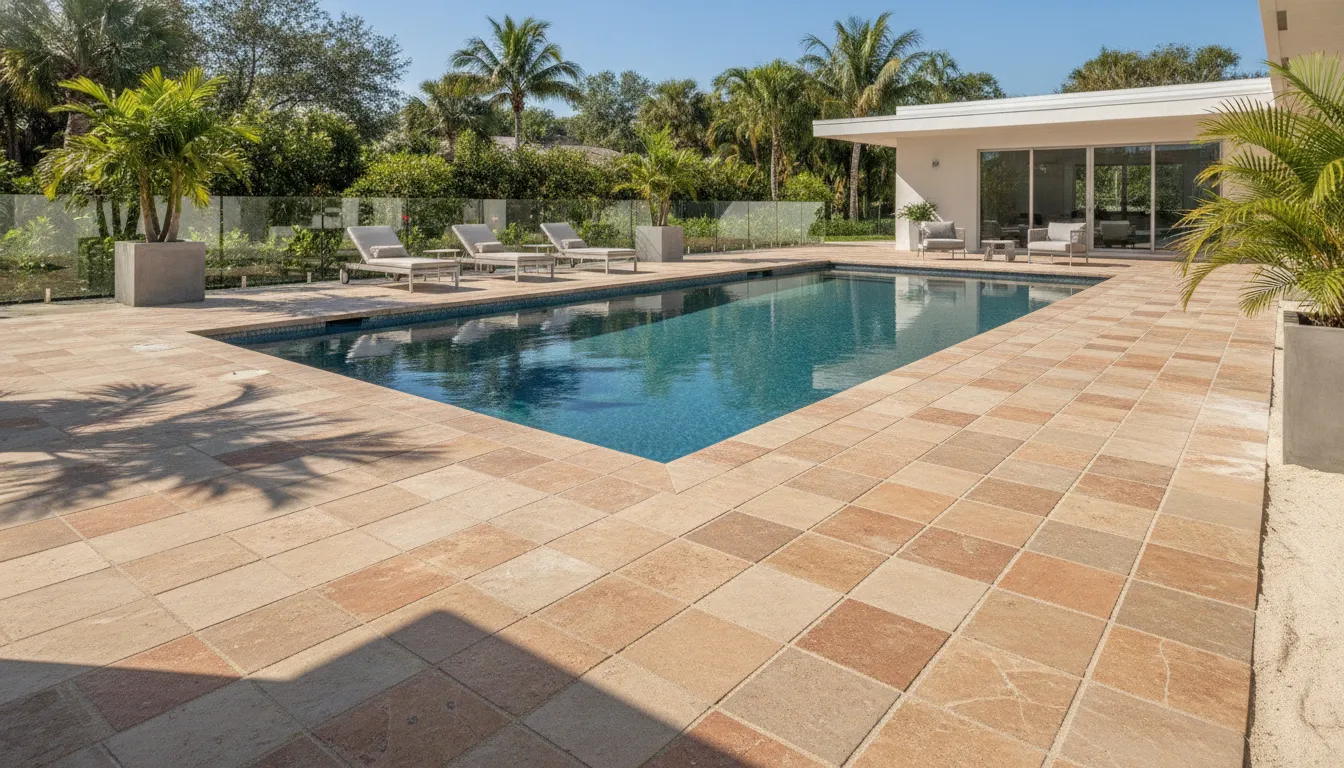
When choosing between porcelain vs travertine pavers for your Florida pool deck, the decision comes down to performance, maintenance, and long-term value. Both materials deliver a high-end aesthetic, but they differ dramatically in how they hold up to sun, pool chemicals, and daily use. This guide breaks down every factor so you can choose with confidence.
Schedule a free project design consultation with our team. Tell us about your pool deck project and we will help you select the perfect paver. Request Your Free Design Today
Porcelain pavers are kiln-fired engineered stone while travertine is a natural limestone. That fundamental difference shapes everything else: durability, stain resistance, maintenance requirements, and lifespan. When you understand how each material performs over decades of Florida weather, the choice becomes much clearer.
Porcelain pavers are kiln-fired at temperatures exceeding 1,200 degrees Fahrenheit, creating an ultra-dense ceramic body that rivals the strength of natural stone. Hardscape.com's porcelain pavers are manufactured by Saxa Gres Group in Italy, combining European ceramic engineering with rigorous quality standards. Unlike natural stone, every porcelain paver is engineered for consistency -- the same density, the same color, the same performance across every single piece.
Key specifications:
Hardscape.com offers porcelain pavers in multiple thicknesses for pool decks. The 2CM pavers are ideal for residential pool decks and patios, while the 3CM pavers handle commercial-grade applications. Browse our full porcelain paver collection to see the range of styles available.
Travertine is a natural limestone formed in mineral springs, prized for its warm, earthy tones and distinctive pitted surface. Its natural beauty has made it a popular choice for luxury outdoor spaces for centuries. However, because travertine is a natural product, quality and appearance vary from batch to batch. Homeowners who choose travertine accept natural inconsistency as part of the appeal, but they also inherit the material's structural weaknesses.
Key characteristics:
In a direct comparison of pool deck materials, porcelain outperforms travertine across nearly every metric that matters for Florida homeowners: strength, stain resistance, maintenance, and lifespan. Below is how they stack up in each category.
Porcelain pavers are dramatically stronger than travertine. With a breaking strength of up to 29,672 N for 3CM pavers. Porcelain supports vehicles over 55,000 lbs -- making it suitable for driveways as well as pool decks. Travertine, while durable for natural stone, can crack or chip under concentrated weight or impact. Porcelain is also frost-resistant, making it ideal for freeze-thaw cycles, while travertine's porous structure can absorb water and crack when frozen.
Winner: Porcelain -- engineered strength far exceeds what natural travertine can deliver. Order samples of our porcelain pavers and feel the difference in density and weight.
This is where the difference is most pronounced. Porcelain is non-porous, meaning pool chemicals, sunscreen, chlorine, and food spills simply cannot penetrate the surface. Travertine, being natural stone, is porous and absorbs liquids readily. That glass of red wine, the spilled soda. Or the chlorinated pool water that splashes onto a travertine deck -- all of it can leave permanent stains unless the stone is sealed constantly.
Porcelain's non-porous surface also means mold, mildew, and algae have nowhere to take hold. In Florida's humid climate, this is a significant advantage. Travertine requires vigilant sealing and prompt cleanup of every spill to avoid permanent discoloration.
Winner: Porcelain -- zero absorption versus a material that requires repeated sealing.
Both materials offer slip-resistant surfaces, but they achieve it differently. Porcelain pavers are engineered with textured surfaces during manufacturing, providing consistent slip resistance across every paver. Travertine's natural pitted surface offers good slip resistance, especially in tumbled styles. However, travertine can become slippery when algae or moss grows within its porous surface -- a common issue in Florida's humid climate. Porcelain's consistent, engineered texture has the edge for long-term slip safety around the pool.
Porcelain pavers require remarkably little care. A simple rinse with a garden hose or light pressure washing keeps them looking new. No sealing, no special treatments, no worrying about stains. Travertine demands regular maintenance. It must be sealed upon installation and resealed every one to three years, depending on the climate. Sealers break down over time, especially around pool water and Florida sun. With proper care over 20 years, the cost of sealing alone can approach the material cost of a porcelain installation.
Winner: Porcelain -- maintenance-free versus a recurring sealing obligation.
Travertine in lighter shades naturally reflects sunlight, keeping the surface cooler underfoot on hot Florida afternoons. Porcelain's temperature depends on its color -- lighter porcelain pavers also stay cooler, while darker shades absorb more heat. The Roma Travertine collection from Hardscape.com offers the warm, light tones of natural travertine in a non-porous porcelain body, combining the best of both worlds.
Slight edge: Travertine -- but only if you compare equivalent light colors; light porcelain performs similarly.
Travertine offers the timeless appeal of natural stone -- warm beige, cream, and ivory tones with natural veining. No two pieces are identical, which appeals to homeowners who want an organic, one-of-a-kind look. But the natural palette is limited to earth tones. Porcelain pavers replicate natural stone with remarkable fidelity. Hardscape.com offers dozens of styles, including the Roma Travertine series that captures the look of natural travertine down to the tumbled edges and subtle color variations. Explore the Roma Travertine porcelain paver to see how closely it matches natural stone.
Porcelain pavers typically last 50 years or more with no maintenance beyond occasional cleaning. The material does not degrade from UV exposure, moisture absorption, or chemical contact. Travertine, when properly sealed and maintained, can also last for decades, but it requires ongoing investment in sealers, repairs for chipped edges, and replacement of damaged pieces.
Winner: Porcelain -- longer lifespan with dramatically less effort.
Travertine generally has a lower upfront material cost than premium porcelain pavers. However, the total cost of ownership tells a different story. Porcelain's lifetime cost is lower because it requires no sealing, fewer repairs, and no replacement pieces due to premature wear. For a typical 500-square-foot pool deck, the total 20-year cost of travertine, including sealing. Repairs and maintenance often exceed that of porcelain, even with porcelain's higher initial material price.
Winner: Porcelain -- lower total cost of ownership over 20 years.
Florida's climate presents specific challenges that make porcelain the practical choice for pool decks. Porcelain resists the intense sun, humidity, and chemical exposure that typify Florida outdoor living, while travertine requires constant maintenance to withstand the same conditions.
Visit one of our Florida showrooms in Jupiter, Boca Raton, Fort Myers, or Tampa to see our porcelain pavers in person.
Yes. Hardscape.com's Roma Travertine porcelain pavers capture the warm, classic look of natural travertine in a durable, non-porous porcelain body. You get the timeless cream and beige tones, the tumbled-edge character, and the old-world charm -- without the constant sealing or worry about stains. The Roma Travertine paver is available in a 24x24-inch format, perfect for pool decks and patios. Homeowners who want the travertine aesthetic but refuse to accept the maintenance burden have a clear solution: choose porcelain that looks like travertine.
Porcelain pavers for pool decks are installed using a sand-set method, which provides excellent drainage, allows for individual paver replacement if needed, and accommodates natural ground movement. This method ensures a durable, stable surface that performs well in Florida's sandy soils and high water tables. The sand-set installation process is straightforward for experienced contractors and allows pool decks to be installed efficiently without heavy equipment or extended cure times.
| Factor | Porcelain Pavers | Travertine Pavers |
|---|---|---|
| Durability | Excellent (29,672N breaking strength) | Good, but chips and cracks over time |
| Stain Resistance | Non-porous -- zero absorption | Porous -- requires sealing |
| Slip Resistance | Engineered textured surface | Good when tumbled, slippery with algae |
| Maintenance | None required | Sealing every 1 to 3 years |
| Lifespan | 50+ years | 15 to 30 years with proper maintenance |
| Design Options | Hundreds of styles | Limited natural palette |
| Total Cost of Ownership | Lower long-term | Higher due to sealing and repairs |
| Heat Performance | Depends on color | Light shades stay cooler |
Choosing between porcelain vs travertine pavers for your pool deck is a significant decision. Porcelain delivers superior durability, zero maintenance, and a longer lifespan -- making it the clear choice for Florida homeowners who want lasting beauty without the constant upkeep. The best way to decide is to see both in person. Request free samples of our porcelain pavers or visit a Florida showroom to compare textures and colors firsthand.
Get started today. Request a free project design and one of our design consultants will help you select the ideal porcelain paver for your pool deck project.