7 Jul
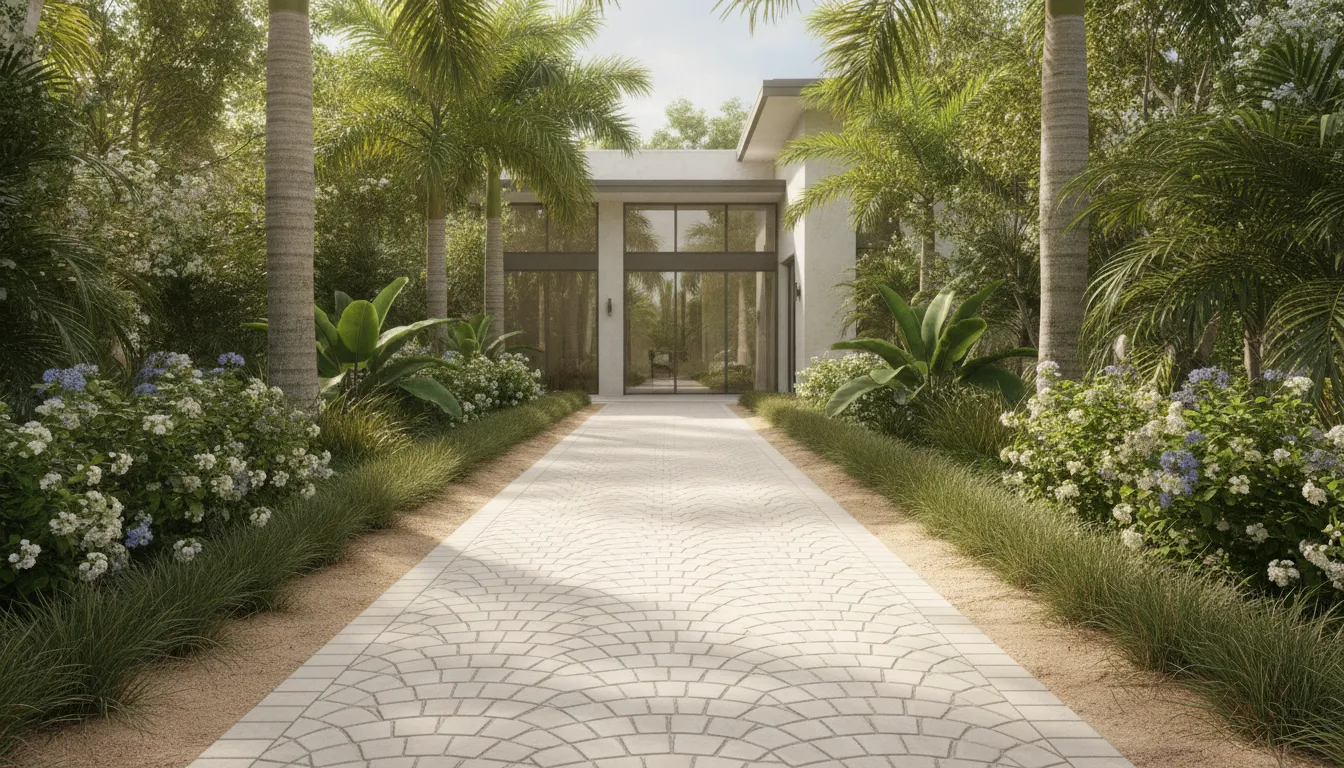
Florida homeowners looking to upgrade their outdoor spaces need materials that endure intense sun, heavy rain, and daily foot traffic without constant upkeep. Porcelain cobblestone pavers deliver the classic look of natural cobblestone with modern durability and near-zero maintenance. Order free samples to see the Basalt and Grigio colors in person, or schedule a free project design consultation to explore layout options for your property.
Porcelain cobblestone pavers offer a waterproof, stain-resistant surface that mimics quarried limestone, granite, or basalt without the upkeep of natural stone. Manufactured at 20mm thickness for residential use and fired at over 2,000 degrees Fahrenheit, these pavers achieve a density of less than 0.5% water absorption. Sand-set installation keeps joints flexible and allows natural drainage, preventing the cracking and shifting that affects mortar-set stone. For Florida homes in Jupiter, Boca Raton, and Fort Myers, these pavers provide a long-term walkway solution. They stay level and bright with only occasional rinsing.
This guide covers design patterns, color options, installation methods, and maintenance comparisons to help you choose the right paver system. Read on to explore the key considerations, starting with what makes porcelain cobblestone a standout material for Florida walkways.
Porcelain cobblestone pavers combine the appearance of traditional quarried stone with superior technical performance. Their near-zero water absorption prevents freeze-thaw damage, stain penetration, and biological growth. The 20mm thickness provides enough structural strength for pedestrian traffic and light vehicle loads. Through-body color pigmentation ensures the surface does not fade or reveal wear patterns over time, unlike surface-coated concrete pavers.
Traditional granite and basalt cobblestones measure 4 to 8 inches across and come from quarries with variable quality. Each stone has unique porosity, color variation, and structural integrity. Porcelain cobblestone pavers replicate these natural textures through digital printing and high-pressure pressing, producing consistent dimensions and uniform performance across every unit. This consistency makes layout planning and installation faster. Every paver fits precisely against its neighbors without sorting or trimming.
Porcelain cobblestone pavers at Hardscape.com come in colors that match natural stone palettes: Basalt (deep charcoal), Grigio (warm grey), and blended tones that coordinate with Florida's coastal and tropical landscapes. The rectified edges create tight 2mm to 3mm joints that resist weed growth and keep the surface smooth for barefoot traffic around pools and patios.
Outdoor flooring in Florida's climate must handle three stress factors: UV radiation, moisture saturation, and thermal cycling. Porcelain stoneware scores well on all three. Independent testing shows porcelain stoneware is robust and impermeable, with breaking strength exceeding 1,300 pounds per square inch for 20mm pavers. Water absorption tests return values below 0.5 percent, which qualifies as impervious under ASTM C373 standards. By comparison, natural limestone has absorption rates of 3 to 10 percent. Concrete pavers range from 5 to 15 percent.
These metrics mean your walkway stays clean with nothing more than a garden hose and a stiff broom. No sealers, no pressure washing contracts, no annual resurfacing. The savings over natural stone add up to an estimated 60 to 80 percent reduction in lifetime maintenance labor.
Most homeowners assume stone pathways require wet mortar or concrete slabs. Porcelain cobblestone pavers use a sand-set method that avoids both. The process layers 4 to 6 inches of compacted Class II road base, 1 inch of bedding sand, and the pavers themselves. Polymeric sand swept into the joints hardens with moisture to lock the surface while still allowing water to percolate through.
This approach is ideal for Florida's sandy soils and seasonal rainfall. The flexible base moves with ground shifts from wet-dry cycles instead of cracking. If underground utility access is needed, workers lift the affected pavers, complete the work, and reinstall them in minutes. No patching, no color mismatch, no demolition waste.
Porcelain cobblestone walkways can be laid in herringbone, running bond, basket weave, or stacked bond patterns. Belgian Block rectangular pavers create a sleek modern look. Curved paths use smaller cobblestones for smooth turns. Color contrast between border and field pavers frames the walkway and adds visual depth. All patterns maintain full structural integrity with sand-set installation.
Creating a distinctive path for your Florida home starts with pattern and layout decisions that match your architectural style. Homeowners in Jupiter and Boca Raton frequently choose porcelain cobblestone for the combination of curb appeal and durability. The decorative paver guide on Hardscape.com provides visual examples of each pattern with application notes.
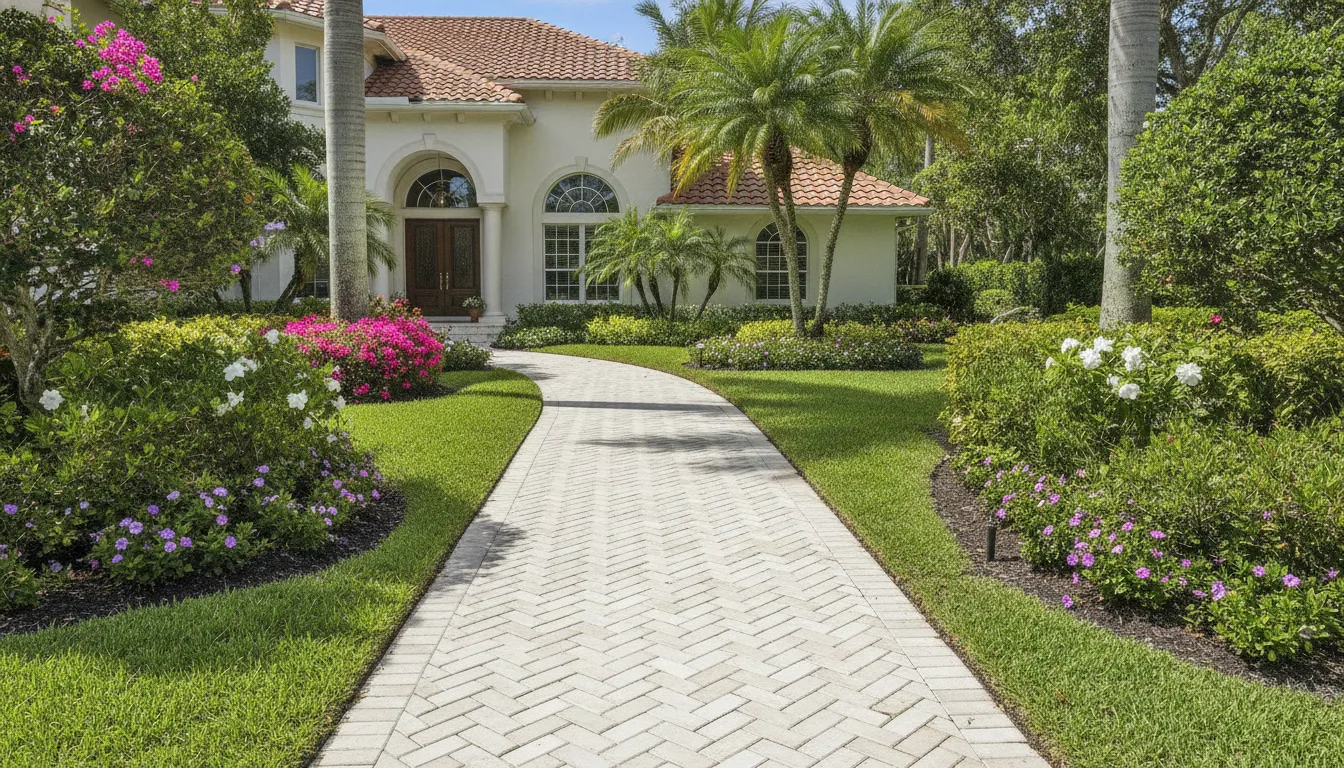
Herringbone layout places pavers at 45- or 90-degree angles to create a V-shaped interlocking pattern. This configuration distributes load across multiple units, making it one of the strongest patterns for straight walkways and driveways. Running bond offsets each row by half a paver length, producing a clean linear look that suits contemporary homes. Basket weave groups pavers in pairs to form a repeating square pattern that evokes historic European streetscapes. Belgian Block rectangular units (10 by 12 inches) laid in a staggered pattern deliver a crisp, uniform surface ideal for modern minimalist landscapes.
Each pattern changes how the walkway reads from the street and from inside the home. Herringbone draws the eye forward, making long paths feel dynamic. Running bond feels restful and orderly. Basket weave and Belgian Block add texture without visual noise. Since all porcelain cobblestone pavers have consistent dimensions, any pattern lays out predictably with minimal cutting waste.
Belgian Block pavers are precision-cut rectangular units with clean 90-degree edges. The uniform shape creates tight joint lines that give walkways a tailored, furniture-like appearance. Basalt delivers a deep charcoal tone that contrasts strongly with light-colored home exteriors and tropical foliage. Grigio offers a softer mid-grey that recedes visually and works well as a field color with darker borders.
Hardscape.com stocks Belgian Block in both 2CM (20mm) and 3CM (30mm) thicknesses. The thicker 3CM option suits driveways and commercial applications where vehicle loads are higher. Both thicknesses carry the same impervious body and through-body color properties. Using porcelain cobblestone pavers for walkways gives you color stability that retains its original tone even after years of Florida sun exposure.
Straight walkways provide a direct visual path from street to entry. They work best with Belgian Block or running bond layouts and suit modern, symmetrical home designs. Curved walkways follow the natural topography of the yard, winding around trees, garden beds, or water features. Smaller cobblestone units (4 by 4 inches or 4 by 8 inches) make curved layouts easier to execute because they rotate more smoothly around radii.
Both straight and curved installations benefit from the same sand-set base. The flexible joint system accommodates the slight angle variations inherent in curved layouts without compromising stability. For curved paths wider than 4 feet. Adding a header course of contrasting pavers along the outer edge helps define the boundary and prevents edge pavers from shifting outward over time.
Porcelain cobblestone entryways use patterned aprons, contrasting borders, and 20mm thick pavers to create grand entrances that resist vehicle traffic, Florida rain, and UV fade. Sand-set installation prevents puddling and allows ground movement without cracking. Fan patterns, running bond layouts, and dark border frames all produce visually striking results that require no sealing or yearly maintenance.
A well-designed entryway increases perceived home value and creates a welcoming transition from street to door. In Florida cities like Jupiter and Boca Raton, the entryway is the first thing visitors and potential buyers see. Using porcelain cobblestone pavers for this high-visibility area ensures it stays photogenic without seasonal maintenance.
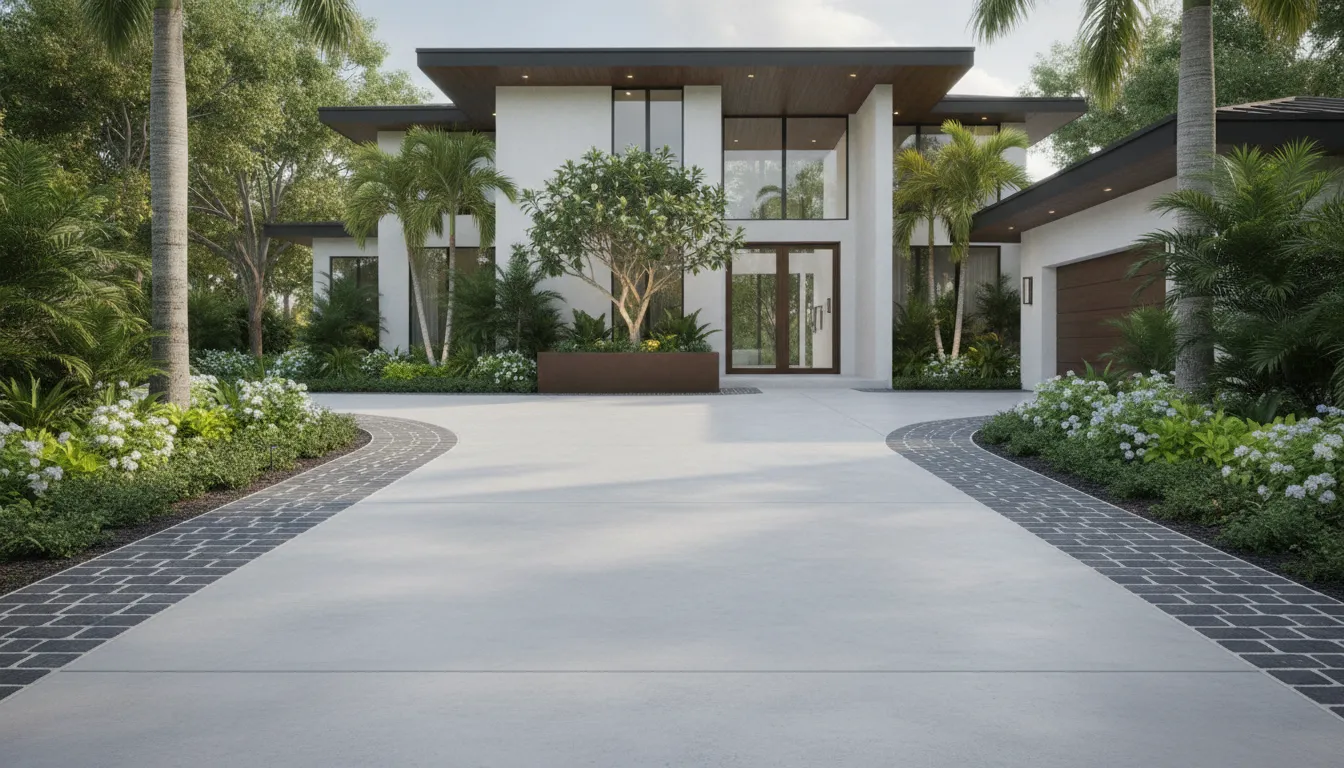
A fan pattern radiates pavers outward from the center point of the driveway or walkway apron. This creates a focal point that anchors the entire entry composition. Running bond aprons work well for wider driveways where the pattern needs to extend without interruption. Adding a contrasting border two pavers wide along the edge frames the apron and prevents the eye from wandering into the surrounding lawn.
Dark grey Basalt borders paired with lighter Grigio field pavers produce a crisp delineation that reads clearly from the street. For Mediterranean or Spanish-style homes, a basket weave border in the same color family adds architectural detail without competing with the main field pattern. The consistent 20mm thickness means border and field pavers sit flush, creating a smooth transition that does not trip foot traffic or catch wheeled luggage.
Entryways bear the heaviest combined load of foot and vehicle traffic on any residential property. Porcelain cobblestone pavers at 20mm thickness support passenger vehicles without cracking or settling. Studies confirm that porcelain stoneware handles repeated impact and bending stress well, with laboratory testing showing no structural degradation after simulated vehicle loading cycles.
Drainage is equally important in Florida's afternoon storm pattern. Sand-set joints allow rainwater to infiltrate the base at rates of 10 to 20 inches per hour depending on soil composition. This prevents sheet flow across the walkway surface that could erode joint sand or cause hydrostatic pressure against the house foundation. The permeable design also reduces mosquito breeding by eliminating standing water in blind spots.
Natural stone entryways require sealing every 12 to 18 months in Florida's climate. Sealer costs range from $0.50 to $1.50 per square foot per application, and the process demands dry weather and cure time. Porcelain cobblestone eliminates this recurring expense entirely. The impervious body resists organic staining from fallen fruits, bird droppings, and leaf tannins that would permanently mark porous limestone or concrete.
Routine maintenance consists of sweeping loose debris and rinsing with a standard garden hose. Pressure washing is safe but unnecessary for routine cleaning. For oil drips in the driveway section, a degreaser applied and rinsed within 24 hours leaves no visible mark. This maintenance profile makes porcelain cobblestone a practical choice for busy families who want luxury curb appeal without dedicating weekends to stone care.
Porcelain cobblestone outperforms natural granite, basalt, and limestone in water resistance, stain resistance, maintenance cost, and dimensional consistency. Natural stone offers unique veining and organic character but requires yearly sealing, has variable porosity, and can chip or spall over time. Porcelain replicates the visual texture of natural stone while delivering engineered uniformity and weather resistance.
Natural granite cobblestones have compressive strength around 20,000 psi, but their porosity creates failure points. Water penetrating microscopic fissures expands during thermal cycling, causing surface spalling and edge chipping within 5 to 10 years of Florida installation. Porcelain cobblestone's absorption rate below 0.5 percent eliminates this failure mechanism entirely. The long-term durability and mechanical properties of porcelain stoneware show no degradation in flexural strength after accelerated aging tests equivalent to 25 years of outdoor exposure.
Impact resistance follows a similar pattern. Natural stone can chip when heavy objects drop on its surface, and the chip propagates along crystal boundaries. Porcelain's homogeneous body distributes impact energy across a wider area, reducing the likelihood of visible damage. When damage does occur on porcelain, the through-body color means repairs or replacements match the surrounding pavers without visible color contrast.
| Factor | Natural Stone | Porcelain Cobblestone |
|---|---|---|
| Water absorption | 3 to 10 percent | Below 0.5 percent |
| Sealing required | Every 12 to 18 months | Never needed |
| Annual maintenance | $0.50 to $1.50 per sq ft | Sweep and rinse only |
| Dimensional tolerance | Variable plus/minus 3mm | Plus/minus 0.5mm |
| Stain resistance | Moderate, sealer dependent | Permanent intrinsic |
| UV stability | Some fading over decades | No fade, through-body color |
Natural stone advocates point to organic variation as a design advantage. That same variation creates practical problems: color batches from different quarry faces may clash, size inconsistencies require field sorting and cutting, and hidden fissures can break during installation. Porcelain cobblestone delivers the visual language of natural stone with engineered predictability. Every paver in a run matches its nominal dimensions within half a millimeter. Color is consistent across the entire order and across reorders months or years later.
For projects requiring tight joint lines, geometric precision, or repeating pattern work, porcelain's consistency saves installation time and produces a cleaner final surface. Cobblestone paver entryways using porcelain achieve the refined look of cut stone without the cost premium of hand-finished natural materials.
Porcelain cobblestone borders define the edges of walkways, patios, driveways, and garden beds. A single row of contrasting pavers creates visual separation and structural containment. Sand-set installation allows borders to flex with ground movement while maintaining their position. Transition borders between paver surfaces and lawn keep grass from encroaching onto the paved area.
A border functions as visual punctuation. It tells the eye where the paved surface ends and the landscape begins. For walkways, a single row of Basalt cobblestones set perpendicular to the main field pattern creates a sawtooth edge that reads clearly from any angle. Patio borders benefit from a wider frame, typically two rows of pavers in a contrasting color or a different orientation.
The 20mm thickness of Hardscape.com's porcelain cobblestone pavers provides enough edge mass to resist lateral movement from foot traffic and landscape maintenance equipment. Borders laid with polymeric sand joints achieve initial stability within 24 hours of installation and continue to strengthen as the sand cures. Porcelain cobblestone pavers used as borders maintain their position even on curved edges, because the sand-set base allows each unit to seat independently without transferring movement to adjacent pavers.
Transition borders manage the junction between different surfaces: walkway to lawn, patio to pool deck, driveway to planting bed. A flush-set border at lawn height allows mower wheels to pass directly over the pavers without scalping the grass or chipping the stone edge. This eliminates the need for string trimming along the paved edge and keeps the border profile clean.
For garden beds, a raised border one paver high creates a low retaining wall that separates mulch from grass. Porcelain cobblestone's impervious body does not wick moisture from the soil, so the border stays dry and does not promote moss or algae growth on the visible face. This matters in Florida's humidity, where porous stone borders develop green staining within one growing season.
The perimeter of any paved area experiences the most stress. Vehicle tires turn on driveways edges. Foot traffic concentrates at walkway borders. Lawn irrigation runoff carries sand away from edge joints. Porcelain cobblestone's density resists these forces better than lighter concrete or natural stone alternatives. The material's specific gravity of approximately 2.4 grams per cubic centimeter gives each paver enough mass to resist displacement from typical edge loads.
For areas with particularly heavy traffic or slope, installing a header course of full-size pavers parallel to the edge adds additional containment. The header course distributes lateral forces across multiple pavers instead of concentrating them at the outermost row.
A cohesive outdoor space uses consistent paver materials, colors, and installation methods across walkways, patios, entry aprons, and pool decks. Limiting the color palette to two tones (one field, one accent) creates visual unity. Using the same sand-set method everywhere ensures consistent drainage and structural behavior across the entire property.
Selecting one primary paver color for all horizontal surfaces creates visual flow that makes even a small property feel larger. Basalt as the primary color gives a modern, grounded feel that contrasts with light stucco exteriors and tropical greenery. Grigio as the primary color produces a softer, airier look that reflects heat and brightens shaded areas. Using a single accent color for borders throughout the property ties the zones together.
Florida homes benefit from ceramic paving materials that balance durability with aesthetics. Porcelain's through-body color means the paver surface, edges, and any cut faces show the same tone. This matters for borders where the exposed edge of the paver is visible, unlike surface-coated products that reveal a different color when cut.
Hardscape.com offers porcelain cobblestone in 4x4, 4x8, and 8x8 inch units. Mixing sizes within the same color family adds visual texture without introducing competing colors. A typical composition uses 60 percent large units (8x8), 30 percent medium units (4x8), and 10 percent small units (4x4) arranged randomly or in a defined pattern. This approach creates the appearance of hand-laid natural stone while maintaining the structural benefits of engineered porcelain.
Different zones can use different scale mixes without breaking visual cohesion. A pool deck might use mostly 8x8 units for a clean, resort-like appearance, while a connecting walkway uses a 4x8 running bond for directional flow. The shared material and color family link the spaces even though the scale changes.
Using sand-set installation across every paved surface on the property ensures consistent drainage, uniform settling behavior, and simplified maintenance. When every zone uses the same base construction (compacted Class II road base, bedding sand, polymeric sand joints), the entire system performs as one integrated structure. Water moves predictably across surfaces. Edges between different zones remain stable because the underlying base is continuous.
This unified approach also simplifies future modifications. Adding a new walkway or expanding a patio connects to the existing sand-set base without transition strips or elevation changes. The consistent paver thickness and joint width keep the entire property looking like a single intentional design instead of an accumulation of separate projects.
Porcelain pavers require far less maintenance than natural stone. Natural stone is porous and needs yearly sealing to block stains and moisture. Porcelain stoneware is dense and impermeable, so it resists stains and frost on its own without chemical treatments. A simple sweep or hose rinse keeps porcelain walkways clean.
A sand-set method is recommended for porcelain cobblestone pavers. This involves laying the units over a compacted gravel and sand base. Sand-set installation allows water to drain through the joints, prevents cracking during temperature shifts, and makes individual paver replacement simple.
Yes. Porcelain cobblestone pavers in 20mm thickness support vehicle weight without cracking. Porcelain stoneware resists heavy impact and bending stress, making it suitable for high-traffic areas like driveways and entryways. The material does not wear down or break under daily vehicle traffic.
Herringbone, running bond, and basket weave patterns all work well with porcelain cobblestone pavers. Herringbone adds flow and depth for long paths. Running bond offers a clean, simple look. Basket weave creates an old-world feel. Belgian Block rectangular pavers in a staggered layout produce a crisp modern appearance.
No. Porcelain cobblestone pavers are through-body colored, meaning the pigment runs through the entire thickness of the material. They resist UV fade even after years of direct Florida sun. Colors like Basalt and Grigio maintain their depth and tone with no ongoing sealing or maintenance.
Bring your design vision to life with premium porcelain cobblestone pavers from Hardscape.com. Our team provides the products, samples, and design support you need for walkway, entryway, and border projects across Florida. We serve homeowners, designers, and contractors in Jupiter, Boca Raton, and Fort Myers.
Order samples to evaluate Basalt and Grigio colors on your actual hardscape, or request a free project design consultation with our experienced design team. For project-specific questions, call us at (561) 998-5000 to speak with a porcelain paver specialist.